
Academics
Course Change/Withdrawal
Students have one week at the beginning of a new semester to request a course change from your counsellor that may or may not be approved after being reviewed by counsellors/administration.
Advanced Placement
The Advanced Placement Program® enables students to take university-level courses and exams while they are still in Secondary School. Through AP courses, students learn to think critically, construct solid arguments, and see many sides of issues that prepare them for college and beyond. The National exam given at the end of the school year (May) is a measurement of your acquired knowledge in a particular subject area. However, the exam has bearing only for post-secondary credit and does not impact your school grade. Passing the AP exam with a score of 3 or higher on a 5-point scale earns college credit that your child may transfer to a university accepting AP credit. Not all universities accept AP credit, or they may require higher than a 3 for credit. Please check with your child’s choice of university to review their policy.
Students may only write AP exams for courses that are offered at Yale. The cost to Yale students enrolled in Yale AP courses is $130.00 for exams ordered by October 31st, and $180.00 per exam ordered between November 1st and March 1st. To facilitate a smooth collection of funds and ensure accurate ordering of exams for those taking them, payment must be made in your School Cash Account prior to the above order dates. If your child should opt not to take the AP exam after orders have been placed, they will incur a $55.00 AP College Board cancellation fee per exam. The remaining balance of your payment will be returned to you.
Graduation Assessments: Gr 10/12 Literacy & Gr 10 Numeracy
As a graduation requirement, students write these provincial assessments.
The Literacy Assessment
Designed to combine the literacy skills students have learned from kindergarten to grade 10, testing their abilities to analyze text and communicate ideas.
How To Prepare
Read, Read, Read. The assessment test’s your ability to consume a piece of media and effectively process the information contained in it. Take notes on what you read, so you can retain what you are reading for when you need to answer questions. You will need have written responses where you come up with an opinion by engaging with text and offering your thoughts. Practice by giving your opinion about a current event. A major component of the assessment is providing a written response to a general idea. Prepare by responding to a variety of prompts found in everyday life. Practice formulating an opinion in a YouTube comment section.
When Writing The Assessment
Read the questions carefully. Some questions will want one answer, whereas others will require multiple responses. Reading a question incorrectly can result in marks lost, so take your time as you analyze each piece of the assessment.
The Numeracy Assessment
The Numeracy Assessment is designed to test a student's ability to interpret, apply, solve, analyze, and communicate drawing on the skills they have acquired from Kindergarten to Gr. 10.The assessment puts emphasis on the practical uses of math and how math can come in handy when trying to solve real-world problems.
Some questions require student to choose just one answer while others allow multiple responses with more than one correct combination of answers.
Students can re-take the Graduation Assessments to improve their proficiency score. Your best level achieved will be counted as your final result and will be reported on students’ transcripts, using a four-point proficiency scale:
- Emerging (initial understanding)
- Developing (partial understanding)
- Proficient (complete understanding)
- Extending (sophisticated understanding)
How To Prepare
- Students should know how to determine the area and perimeter of two-dimensional shapes such as rectangles, circles, and triangles. Knowing the formulas for the volume of three-dimensional objects such as rectangular prisms, spheres, and cylinders will prove useful as well. The practical applications of these shapes are endless, so they’re bound to show up on the assessment.
- Students should also be confident with calculating and interpreting various rates. Dollars per item when shopping, kilometres per hour when driving, and words per minute when typing are just a few of the ways rates can show up in life and on the assessment. Students can use rates to determine everything from the efficiency of employees at a company to the electricity used by an appliance in a day.
Sample Numeracy Assessment
https://bced.vretta.com/#/en/bced-landing/grad/sample/numeracy10
Sample Literacy Assessment
https://bced.vretta.com/#/en/bced-landing/grad/sample/literacy10
School-Based Semester-End Assessments
Semester End/School-based Course assessments are administered near the end of each semester: late January and late June. There is an expectation that Yale students will have completed the course requirements prior to writing their Semester End/School-based Course Exam. This expectation ensures that each student is adequately prepared for the examination. There is also an expectation that students will write their Semester End/School-based Course Exams on the scheduled day. Schedules for these exams will be posted and/or communicated to students by classroom teachers near the end of each semester.
Career Centre
Would you like to work as an Electrician, in Construction, Auto Mechanic, Professional Cook etc. while you are in high school? Stop by today and see what is available to you and to register. Students may visit the Career Centre for information concerning Police, Fire, Hospital Academies, Trade Apprenticeships, and Post-Secondary Counselling/Advising. For university and college information from across Canada and the USA. The Career Centre is located in the Learning Commons. Drop in at lunch or after school or schedule an appointment. All grades welcome!
Other areas of information include:
- Work Experience 12 (earn up to 16 credits from working)
- Volunteer opportunities - police, fire, hospital, schools (earn 4 credits)
- Apprenticeships (starts working in the trades - earn a scholarship)
- Participating in a Co-op program where students can work for a semester
- Post-secondary advice/assistance
- Enter into a District Career Program (refrigerator mechanic, drafting, hairstylist, cook, electrician, welding, construction, landscaping, operating heavy equipment, auto mechanics, and animation arts.
Mr. Byron – Career Programs Coordinator [email protected]
Academic Study Block
Yale Secondary offers a rich variety of courses, and we believe that students should take advantage of the opportunity for a full education. An academic Study Block is a privilege reserved for Gr 12 students who have challenging academic course loads. If you qualify, you can have only one Study Block in during the school year. During a Study Block, students are expected to be in one of the following areas: student lounge, multipurpose area, Learning Commons, or the cafeteria.
All applicants must have:
- Excellent attendance in their previous year
- Good work habits
- 4 university entrance approved Academic grade 12 courses. (Non-Yale courses do not qualify)
- NO disciplinary record/issues.
- Students in Grades 9-11 will not be eligible for a Study.
- Students in academies will be considered on an individual basis.
- Students with a history of poor attendance or academic non-performance will be denied a Study Block.
- Grade 12 students taking an online course with a DL or AVS (Distance Learning or Abbotsford Virtual School) support block may not be considered for a Study Block in that semester.
Homework
Students are expected to do all work assigned by their teachers. Students are expected to do regular home study which is the review, reading and preparation that goes beyond homework. Failure to do homework may result in teacher assigned consequences.
BYOD (Bring Your own Device)
Students are encouraged to bring a laptop from home to enhance their learning experience, as teachers are increasingly integrating technology into their courses. Having easy and regular access to a device will significantly benefit students for research, inquiry, projects, and more. Internet access allows students' curiosity to flourish. When a student uses their device to answer a question, it often leads to more in-depth and insightful inquiries, fostering deeper learning. While teachers will have a limited number of extra devices available for student use, bringing a personal laptop ensures consistent access to these valuable resources.
New Ministry Gr 9 Reporting Policy
Over the last few years our district has been moving over to the new Kindergarten to Grade 12 Report Policy, under the direction of the Ministry of Education and Child Care. Parents and students will have seen this as many report cards at Elementary and Middle have shifted to using a new proficiency scale for students in kindergarten to grade 9.
This new policy includes a greater emphasis on student self-assessment of the Core Competencies and personal goal setting for student success.
The Ministry has created a website portal to help support parents in understanding the new assessment goals and scale, including providing detailed information in a number of languages.
Here is a Summary of information, but, a detailed video guide, and answers to all your questions are available here: https://curriculum.gov.bc.ca/reporting/resources-for-parents-and-caregivers
Grade 9 Report Card
- proficiency scale
- written comments

Percentages and Letter Grades 10-12
Note, students in grades 10 to 12 will continue to use letter grades and percentages.
Students with incomplete work or who are in danger of failing will be issued an “IE” (Incomplete). In consultation with teachers, students may be given an extended opportunity to complete the required work.
|
A = 86 - 100% B = 73 - 85% C+ = 67 - 72% C = 60 - 66% C- = 50 - 59% IE / F = 0 - 49% (IE) = Insufficient Evidence |
Grades 10-12 Report Card
- percentages
- written comments
How Yale Teachers Communicate Student Progress
Ongoing learning updates
- Meetings
- Phone calls
- Emails
- Assessed work sent home
- Portfolios
- Student presentations
Formal Learning Updates
- November & April Learning Update (9-12)
- Summary of Learning: February & June report cards (9-12)
- Report cards written in MyEducation BC
- Core competencies and student goal setting – 2x a year as part of reporting
Information for Parents and Caregivers
How will I know how my child is doing?
Why is my child not getting letter grades?
Why is my child self-reflecting and setting goals?
How will I know my child is on track to graduate?
Student Recognition-Under Review
Details will come out soon.
Student Of the Month
Each month we select a Gr. 12 student that goes above and beyond in (extra-curricular, service to others, demonstrating good virtues etc.). The teacher nominated student meets the following criteria:
- Demonstrate school spirit.
- Have a positive influence on self and others.
- Make a positive difference in the school / or community.
- Demonstrate a notable commitment to outstanding achievement in academics, fine arts, and / or technology / applied skills.
- Demonstrate a commitment to leadership in and around the school or community.
Year End Awards of Excellence
Program Awards
Awards for each program are awarded based not only on marks, but on effort, participation, and proficiency in personal and social competencies.
Service Medals
In recognition of outstanding service to the school and greater community in which we live
Specialty Awards
- Math & Science Contests
- Outstanding Grade 10 Scholar: High proficiency of achievement across subject areas (including PEHE, Arts Education, Career Education, and ADST), and in both academic achievement and Personal and Social competencies (considering both personal and social responsibility).
- The top Grade 10 student at your school will receive a certificate of achievement and a cheque in the amount of $200.
Major Awards
Outstanding Leadership
Presented to a student who has demonstrated outstanding Leadership above and beyond any course expectations. Strong candidates have exemplary attendance and are role models to the student body.
Abbotsford Police Shield (Outstanding Service)
Presented to a student who has demonstrated outstanding service inside and outside the classroom. This student demonstrates outstanding community service, diversity and equality and is an outstanding mentor. Strong candidates have exemplary attendance and are role models to the student body.
Citizenship Award (for total kindness and inclusiveness)
The recipients will have demonstrated throughout the year: 1. Respect for school rules and expectations 2. The ability and willingness to work with others 3. Polite manners 4. Kindness 5. Honesty in all aspects of school life. Strong candidates have exemplary attendance and are role models to the student body.
Academic Dishonesty
We expect students to strive for academic excellence in an honest manner. We value academic integrity and ethical behavior, and will not tolerate academic misconduct of any kind including:
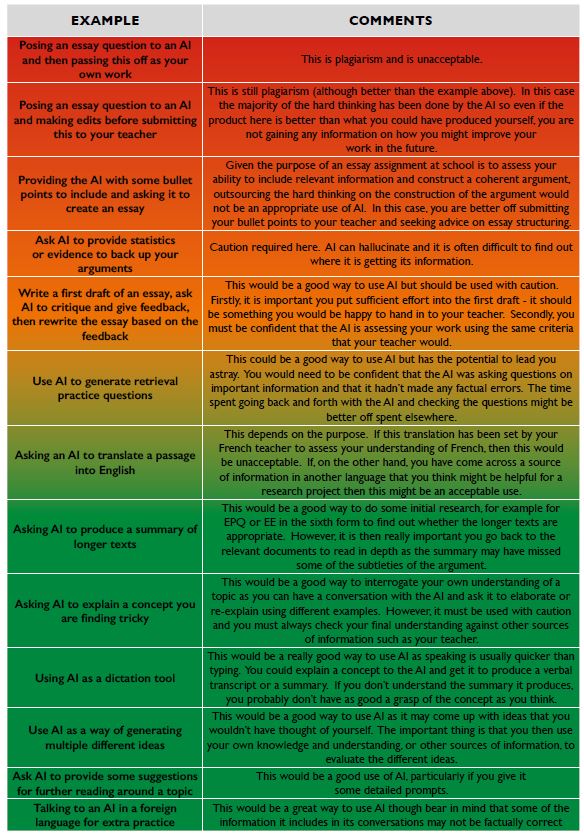
Utilizing an AI (artificial intelligence) to generate your work
All student work is expected to be original and appropriately sourced (student identifies when work is not their original idea and properly cites the original source). Any student work that is not cited appropriately may be determined to be plagiarized. As with any technology, AI can be used to support learning or it can be deterimental to the learning process. The following gives some suggestions for how AI might be used appropriately at Yale and some examples of inappropriate use. The list is not exhaustive and never could be given the nature of this rapidly advancing field. It is the learning process that is important so you should ask yourself whether the AI is helping you with that process or if it is outsourcing the hard thinking. If in doubt, ask your teachers!
Plagiarizing:
- Copying work or homework, or lending any of your work to another student to be copied.
- Representing any part of your work as your own that is not (this includes information from Internet sites).
Cheating:
- Talking/communicating in any way with other students during a test.
- Having any unauthorized test-related material on or near the student’s desk during a test.
- Cell phone use.
- Failing to adhere to verbal or written testing guidelines.
- Copying AI-generated material.
Collusion:
- Knowingly or intentionally helping another student to perform any act of cheating or plagiarism.
Consequences:
First Occurrence:
- The teacher will contact the student’s parents.
- Administration will be informed of the event and the incident will be recorded in the students' conduct file.
- In some instances, the student may be given another opportunity to complete the assignment or an alternate assignment/exam.
- Students may serve a one-day in-school suspension to complete the assignment or an alternate assignment/exam.
Second and Subsequent Occurrences:
- The teacher will contact the student’s parents.
- Administration will be informed of the event and the incident will be recorded in the student file.
- Repeated offences may result in out-of-school suspension and students not being eligible for year-end awards.
- The student may be given another opportunity to complete the assignment or an alternate assignment/exam.